mirror of
https://github.com/langgenius/dify-docs.git
synced 2026-03-27 13:28:32 +07:00

65 lines
4.0 KiB
Plaintext
65 lines
4.0 KiB
Plaintext
---
|
||
title: Create Knowledge Base
|
||
---
|
||
|
||
Steps to upload documents to create a knowledge base:
|
||
|
||
1. Create a knowledge base and import either local document file or online data.
|
||
|
||
<Card title="Import text data" icon="link" href="import-content-data">
|
||
Create a knowledge base and import either local document file or online data.
|
||
</Card>
|
||
|
||
2. Choose a chunking mode and preview the spliting results. This stage involves content preprocessing and structuring, where long texts are divided into multiple smaller chunks.
|
||
|
||
<Card title="Choose a hunk mode" icon="link" href="chunking-and-cleaning-text">
|
||
Choose a chunking mode and preview the spliting results. This stage involves content preprocessing and structuring, where long texts are divided into multiple smaller chunks.
|
||
</Card>
|
||
|
||
3. Configure the indexing method and retrieval setting. Once the knowledge base receives a user query, it searches existing documents according to preset retrieval methods and extracts highly relevant content chunks.
|
||
|
||
<Card title="Select the indexing method and retrieval setting" icon="link" href="setting-indexing-methods">
|
||
Configure the indexing method and retrieval setting. Once the knowledge base receives a user query, it searches existing documents according to preset retrieval methods and extracts highly relevant content chunks.
|
||
</Card>
|
||
|
||
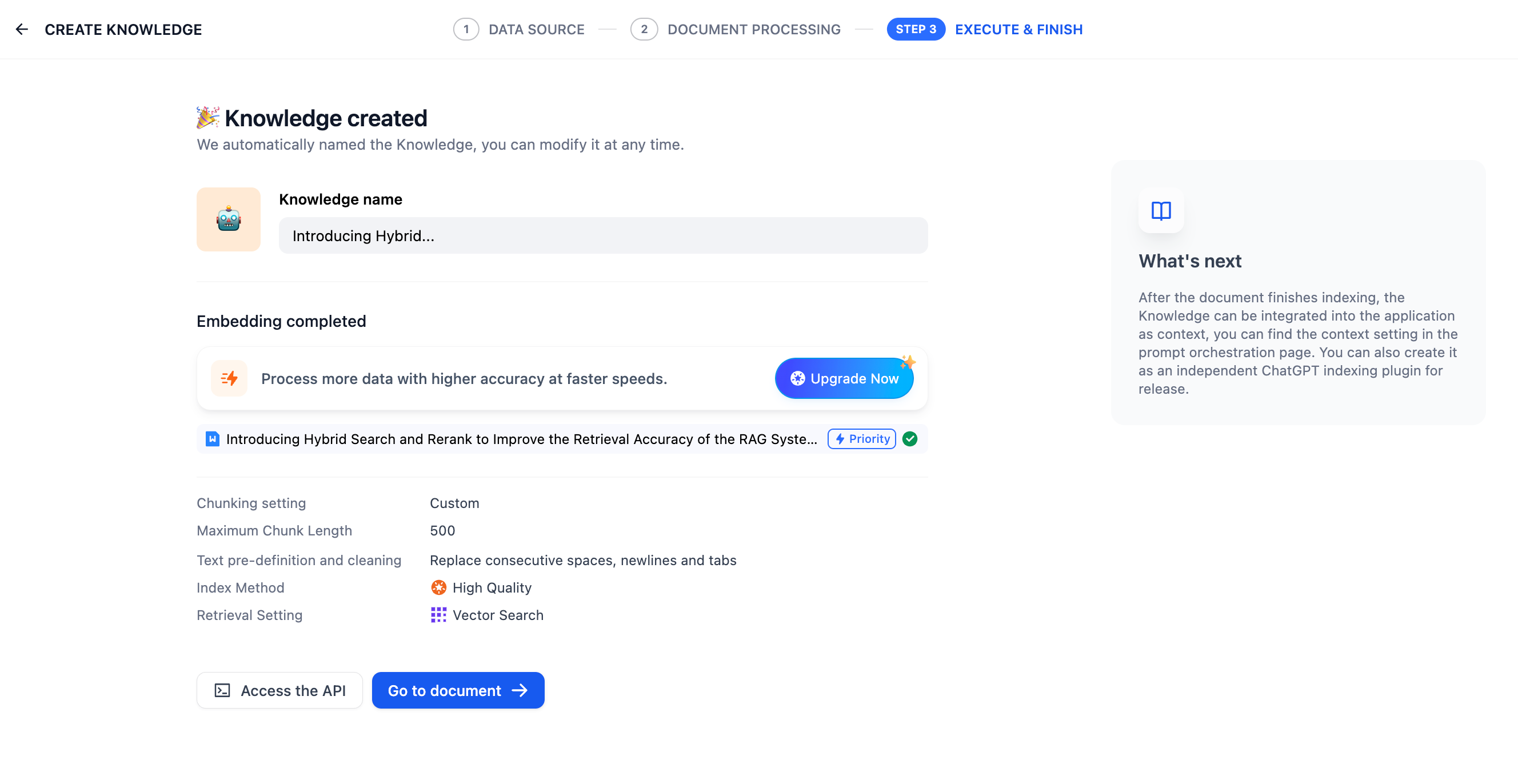
4. Wait for the chunk embeddings to complete.
|
||
|
||
5. Once finished, link the knowledge base to your application and start using it. You can then [integrate it into your application](../integrate-knowledge-within-application) to build an LLM that are capable of Q\&A based on knowledge-bases. If you want to modify and manage the knowledge base further, take refer to [Knowledge Base and Document Maintenance](knowledge-and-documents-maintenance.md).
|
||
|
||
|
||
|
||
***
|
||
|
||
### Reference
|
||
|
||
#### ETL
|
||
|
||
In production-level applications of RAG, to achieve better data retrieval, multi-source data needs to be preprocessed and cleaned, i.e., ETL (extract, transform, load). To enhance the preprocessing capabilities of unstructured/semi-structured data, Dify supports optional ETL solutions: **Dify ETL** and [**Unstructured ETL**](https://unstructured.io/).
|
||
|
||
> Unstructured can efficiently extract and transform your data into clean data for subsequent steps.
|
||
|
||
ETL solution choices in different versions of Dify:
|
||
|
||
* The SaaS version defaults to using Unstructured ETL and cannot be changed;
|
||
* The community version defaults to using Dify ETL but can enable Unstructured ETL through [environment variables](../../getting-started/install-self-hosted/environments.md#zhi-shi-ku-pei-zhi);
|
||
|
||
Differences in supported file formats for parsing:
|
||
|
||
| DIFY ETL | Unstructured ETL |
|
||
| ------------------------------------------------------- | --------------------------------------------------------------------------------------- |
|
||
| txt, markdown, md, pdf, html, htm, xlsx, xls, docx, csv | txt, markdown, md, pdf, html, htm, xlsx, xls, docx, csv, eml, msg, pptx, ppt, xml, epub |
|
||
|
||
<Info>
|
||
Different ETL solutions may have differences in file extraction effects. For more information on Unstructured ETL’s data processing methods, please refer to the [official documentation](https://docs.unstructured.io/open-source/core-functionality/partitioning).
|
||
</Info>
|
||
|
||
#### **Embedding**
|
||
|
||
**Embedding** transforms discrete variables (words, sentences, documents) into continuous vector representations, mapping high-dimensional data to lower-dimensional spaces. This technique preserves crucial semantic information while reducing dimensionality, enhancing content retrieval efficiency.
|
||
|
||
**Embedding models**, specialized large language models, excel at converting text into dense numerical vectors, effectively capturing semantic nuances for improved data processing and analysis.
|
||
|
||
#### **Metadata**
|
||
|
||
For managing the knowledge base with metadata, see *[Metadata](../metadata)*.
|