mirror of
https://github.com/langgenius/dify-docs.git
synced 2026-03-28 13:38:36 +07:00

145 lines
4.5 KiB
Plaintext
145 lines
4.5 KiB
Plaintext
---
|
||
title: Loop
|
||
---
|
||
|
||
## What is Loop Node?
|
||
|
||
A **Loop** node executes repetitive tasks that depend on previous iteration results until exit conditions are met or the maximum loop count is reached.
|
||
|
||
## Loop vs. Iteration
|
||
|
||
<table>
|
||
<thead>
|
||
<tr>
|
||
<th>Type</th>
|
||
<th>Dependencies</th>
|
||
<th>Use Cases</th>
|
||
</tr>
|
||
</thead>
|
||
<tbody>
|
||
<tr>
|
||
<td><strong>Loop</strong></td>
|
||
<td>Each iteration depends on previous results</td>
|
||
<td>Recursive operations, optimization problems</td>
|
||
</tr>
|
||
<tr>
|
||
<td><strong>Iteration</strong></td>
|
||
<td>Iterations execute independently</td>
|
||
<td>Batch processing, parallel data handling</td>
|
||
</tr>
|
||
</tbody>
|
||
</table>
|
||
|
||
## Configurations
|
||
|
||
<table>
|
||
<thead>
|
||
<tr>
|
||
<th>Parameter</th>
|
||
<th>Description</th>
|
||
<th>Example</th>
|
||
</tr>
|
||
</thead>
|
||
<tbody>
|
||
<tr>
|
||
<td>Loop Termination Condition</td>
|
||
<td>Expression that determines when to exit the loop</td>
|
||
<td><code>x < 50</code>, <code>error_rate < 0.01</code></td>
|
||
</tr>
|
||
<tr>
|
||
<td>Maximum Loop Count</td>
|
||
<td>Upper limit on iterations to prevent infinite loops</td>
|
||
<td>10, 100, 1000</td>
|
||
</tr>
|
||
<tr>
|
||
<td>Loop Variables</td>
|
||
<td>Values that persist across iterations and remain accessible to nodes after the loop completes</td>
|
||
<td>A counter <code>x < 50</code> increases by 1 each iteration. Use it for calculations inside the loop, then access its final value in later workflow steps.</td>
|
||
</tr>
|
||
<tr>
|
||
<td>Exit Loop Node</td>
|
||
<td>Immediately ends the loop when reached</td>
|
||
<td>Caps execution at 10 iterations, regardless of other conditions.</td>
|
||
</tr>
|
||
</tbody>
|
||
</table>
|
||
|
||
<Info>
|
||
The loop can be terminated by either the **Exit Loop Node** or the **Loop Termination Condition**. When either condition is met, the loop will immediately exit.
|
||
|
||
If no exit conditions are specified, the loop will continue executing (similar to `while (true)`) until it reaches the **Maximum Loop Count**.
|
||
</Info>
|
||
|
||
## Example 1: Basic Loop
|
||
|
||
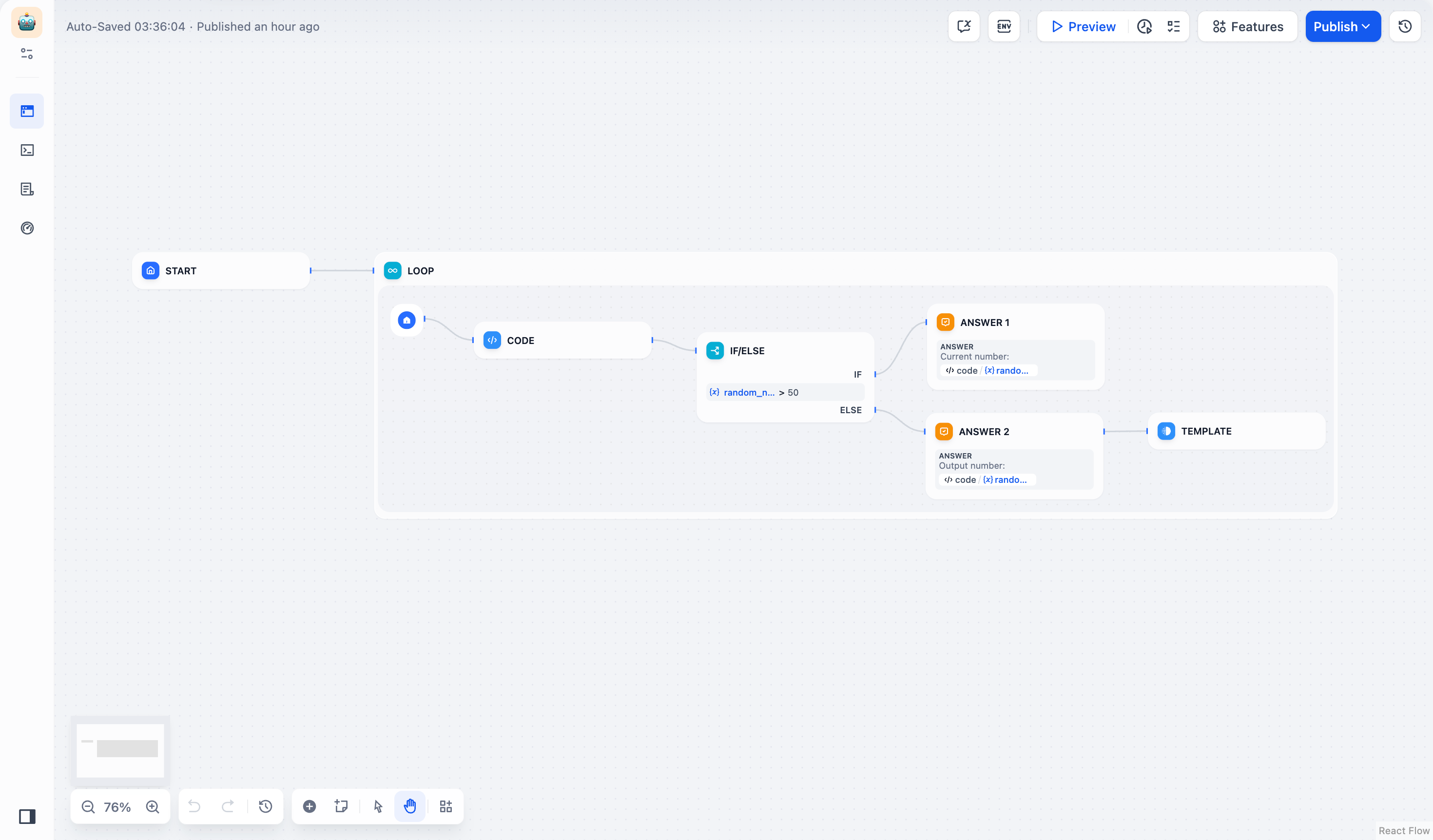
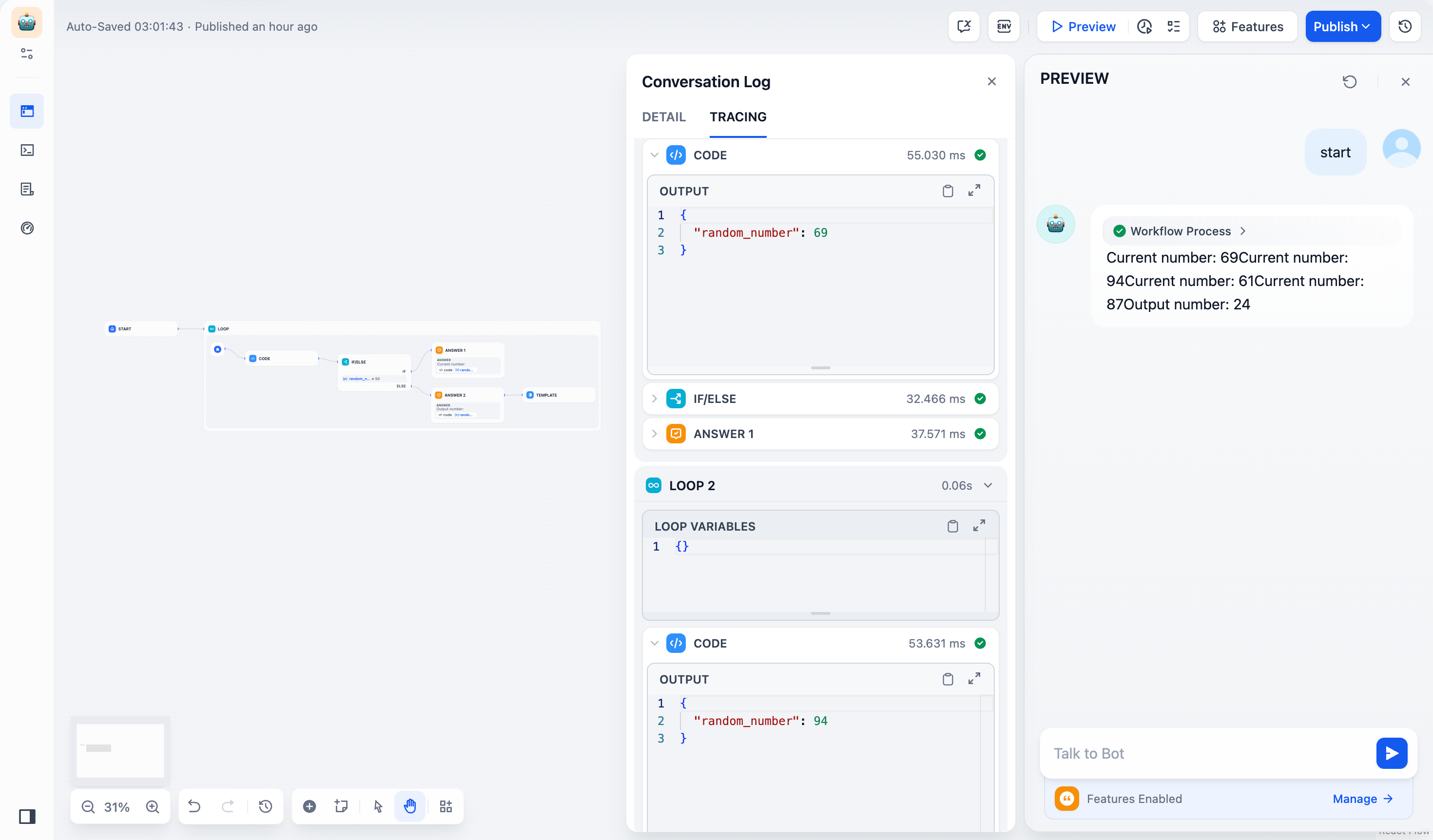
**Goal: Generate random numbers between 1-100 until getting a number less than 50.**
|
||
|
||
**Steps**:
|
||
|
||
1. Set up a **Loop** node by configuring its **Loop Termination Condition** to trigger when the **Template** node returns `done`.
|
||
|
||
2. Set up a **Code** node that generates random integers between `1` and `100`.
|
||
|
||
3. Set up an **IF/ELSE** node with the following logic:
|
||
|
||
- For numbers ≥ 50: Output the `Current Number` and continue the loop
|
||
|
||
- For numbers < 50: Output the `Final Number`, and then use the **Template** node to return `done`
|
||
|
||
4. The workflow terminates automatically once a number below `50` is generated.
|
||
|
||
|
||
|
||
|
||
|
||
## Example 2: Advanced Loop (with Variables and Exit Node)
|
||
|
||
**Goal: Design a workflow that generates a poem through four iterative refinements, with each version building upon the previous one.**
|
||
|
||
**Steps:**
|
||
|
||
1. Set up a **Loop** node with those **Loop Variables**:
|
||
|
||
- num: A counter starting at 0, incrementing by 1 per iteration
|
||
|
||
- verse: A text variable initialized with `I haven't started creating yet`
|
||
|
||
2. Set up an **IF/ELSE** node that evaluates the iteration count:
|
||
|
||
- When num > 3: Proceed the **Exit Loop** node
|
||
|
||
- When num ≤ 3: Proceed to the **LLM** node
|
||
|
||
3. Set up an **LLM** node to generate poems.
|
||
|
||
<Info>
|
||
Example Prompt:
|
||
|
||
You are a European literary figure who can create poetic verses based on `sys.query`.
|
||
|
||
`verse` is your last creation. You can progress based on your previous work.
|
||
</Info>
|
||
|
||
The first iteration begins with the initial verse value `I haven't started creating yet`. Each subsequent iteration builds upon the previous output, with the new poem replacing the verse variable’s content.
|
||
|
||
4. Set up a **Variable Assigner** node to manage state:
|
||
|
||
- Increment num by 1 after each iteration
|
||
|
||
- Update verse with the newly generated poem
|
||
|
||
5. When executed, the workflow will produce four versions of your poem, each iteration building upon its previous output.
|
||
|
||
<video controls src="https://assets-docs.dify.ai/2025/04/7ecfc04458aa38e721baaa5f6355486c.mp4" width="100%"></video>
|
||
|
||
{/*
|
||
Contributing Section
|
||
DO NOT edit this section!
|
||
It will be automatically generated by the script.
|
||
*/}
|
||
|
||
---
|
||
|
||
[Edit this page](https://github.com/langgenius/dify-docs/edit/main/en/guides/workflow/node/loop.mdx) | [Report an issue](https://github.com/langgenius/dify-docs/issues/new?template=docs.yml)
|
||
|